GlobalIntelHub2

The Exquisite Art Of Marketing To Pauperized Consumers (By Hiding Inflation)

While workers in the upper income categories, those who don’t have to worry about the price of toilet paper, have seen their incomes rise sharply over the years, the rest have been in a long downward spiral. To take just one measure: median household income, adjusted for inflation, has dropped 7.8% since 2000 (chart). The drop has been steeper for the lower income categories. These are the folks who do worry about the price of toilet paper. And for them, Kimberly-Clark Corp. and other tissue makers have a special strategy: “Desheeting.”
A word that top executives of personal-care conglomerates are proudly bandying about because it speaks of their corporate spirit of relentless innovation. And it cropped up during Kimberly-Clark’s second-quarter earnings call.
CFO Mark Buthman set the scene when he extolled “organic” sales growth of a whopping 3% in the second quarter, though actual sales, at $5.267 billion, were down fractionally year over year. A continuation of a worsening trend: in 2011, sales rose 5.5%. In 2012, sales rose only 1.0%, not even keeping up with inflation – a topic that came up a lot during the earnings call. In 2013, revenues look to be even more lackadaisical.
One exasperated analyst wanted to know with regards to the healthcare division, “Why do we have four quarters in a row of negative sales growth?”
“Yes. A couple of things,” retorted CEO Tom Falk, sticking to the rule of answering hairy questions with a yes; it would bamboozle everyone into having a positive attitude about the answer. “I think everybody in the healthcare space is trying to figure that out,” he said because his company wasn’t the only one with that problem. He ascribed it to high-deductible healthcare plans that encouraged consumers to make smart decisions; and to healthcare providers that pushed for “alternate therapies” before venturing into surgery. These efforts to tamp down on ballooning healthcare costs were giving his revenue-challenged company conniptions.
Yet Kimberly-Clark continues to eke out “adjusted earnings” growth – 8% per share in the second quarter. What gives? All manner of cost cutting, product-mix changes, and that word.
“Well, we took some desheeting in the quarter,” explained Mr. Buthman. The company was reducing the sheets on each roll of toilet paper and in each box of Kleenex. He called it an “innovation” that would lead to a “more positive” price. At the same time, volume, which the company counted in thousands of sheets, would decline. “Which net net, for us, works out to be a positive,” he said.
Citing the improved Cottonelle toilet paper line, he told an analyst, “It’s a great product, great category, growing rapidly. We will have to get you some, Connie, to try it.”
His strategy: “identifying and delivering cost savings in areas that our consumers and customers don’t care about….”
Because it’s tough out there. No revenue growth. Input prices that are increasing. Customers who can’t afford price increases. “Adjusted earnings” that have to increase. Solution: desheeting – rolls and boxes with fewer sheets. Consumers “don’t care about” that because they’re not supposed to notice.
Part of the innovation is to fluff up the tissue without adding more materials – 15% “bulkier,” it said on a box of Kleenex that had 13% fewer sheets in it, the Wall Street Journal discovered. In the Cottonelle line, sheet counts dropped by 5.7% to 9.6%. Fewer but fluffed up sheets, lower input costs for the company, and consumers who “don’t care about” that. A perfect solution – and a variation on an ancient theme – for hiding hefty price increases.
Other tissue makers are doing it too. They’re cutting the number of sheets per roll or box, they cutting the size of the sheets, and they’re fluffing up sheets to give consumers, as Mr. Buthman explained so eloquently in an interview, a “better, stronger, tissue so that you need fewer sheets to get the job done.”
But the math of getting “the job done” doesn’t quite work out that way. If someone for a particular “job” normally uses two sheets, he isn’t going to suddenly use 1.95 sheets for the same job to compensate for a 5% cut in sheet count, regardless of how fluffy and improved that innovative sheet may be. He’s going to use two sheets as before, and he’s going to buy more rolls and spending more money. If Kimberly-Clark’s cost-cutting and pricing strategy is working, he’ll never notice, though he might start wondering after a while where all his money is going.
Kimberly-Clark knows where his money is going. It’s propping up “adjusted earnings.” This is the high art of marketing to consumers who have been pauperized in small, nearly unnoticeable increments by over a decade of wage increases – for the lucky ones – that haven’t kept up with what the Fed is so passionate about creating: moderate inflation.
But the Fed has a problem. Foreigners have been big buyers of Treasuries. That buying collapsed during the financial crisis. Now, worried foreigners are once again bailing out. So far, the Fed has been picking up the slack. But what if the Fed were to “taper” those purchases, and long-term rates were to jump? Read….  Rising US Interest Rates Could Create An Economic Death Cycle. So Can The Fed Actually Taper QE?
Continue Reading
GlobalIntelHub2

Economics Cannot Trump Mathematics

Originally posted at Monty Pelerin’s World blog [4],

Extreme Fear Is Reasonable
It is nearly impossible to convince people that an economic ending is likely, perhaps inevitable. It is beyond anything they have seen or can imagine. I attribute that to a normalcy bias, an inherent weakness of experiential learners. For many, accepting something that has not occurred during their time on the planet is not possible. The laws of economics and mathematics may shape history but they are not controlled by history.
The form of cataclysm and its timing is indeterminable. Political decisions continue to shape both. The madmen who are responsible for the coming disaster continue to behave as if they can manage to avoid it.  Violating Einstein’s definition of insanity, they continue to apply the same poison that caused the problem. These fools believe they can manage complexities they do not understand. We are bigger fools for providing them the authority to indulge their hubris and wreak such damage.
Apocalypse In One Picture
James Quinn [5] provided the following graph. If a picture is worth a thousand words, this graph is worth millions. The route to economic demise is depicted below:
debt-and-gdp1Quinn [6]

The relationships in this graph are terrifying! Debt is shown relative to GDP. GDP growth has been one-third the growth in debt for the period. That is, the economy required $3 of debt to produce $1 more in real GDP. In recent years diminishing returns to debt required $6 of debt to increase GDP a $1. Whatever the benefits of debt, they have clearly diminished, almost to zero. Debt expansion has gone exponential in order to salvage the weak growth in GDP.
To put this into a perspective the average reader can understand, think of GDP as a household’s spending. The “family” depicted above has to borrow each year in order to maintain its spending level. Imagine the condition of your family if you borrow ed 6 times the amount of incremental spending each year. Then imagine the condition of your family after forty years of continuously increasing your debt levels substantially in excess of your income.
It is impossible for a family without a printing press and a cooperative Federal Reserve to engage in such behavior. The government is different, you say? Surely it is, but not necessarily in a meaningful financial manner. Just as you would not survive such behavior, governments cannot either. History is full of examples of government collapses resulting from excessive debt and overspending. A printing press only provides the luxury of more time before the failure.
GDP Long-Term Real GDP Growth [7]

You may object that a macroeconomy is different from a family. Debt (parroting the political claim) makes an economy grow faster. The evidence shown to the right does not support this claim. Government reported GDP growth rates are shrinking as the debt expansion accelerates. Since 1965 the growth rate of the economy has been declining.
Even if you accept government GDP reporting, the chart to the right shows a trend this is pointing to an average declining standard of living. That point will be reached when the GDP growth falls below the population growth.
The US economy has been underperforming since the 1970s according to government’s statistics. That is after all the games have been played with these numbers. How much longer can these trends continue and what happens at the end? No one can reasonably answer either of these questions.
What Is Known And Not Known
Two things are known:

  • So long as borrowing increases faster than GDP, the ability to repay diminishes. That has been occurring for more than forty years and the differential growth rates have widened dramatically in recent years. 
  • Not borrowing at this pace would likely have decreased reported GDP dramatically. While that may have been a proper economic response, it is now politically impossible (or highly unlikely).

Continuing to increase debt at a rate greater than GDP ensures financial collapse. Stopping or slowing down at this point likely leads to the same point. This country has maneuvered itself into a no-escape situation.
What would happen to GDP and the standard of living if borrowing were dramatically reduced? How much of the last $10 trillion in debt borrowed between 2000 and 2009 went directly into reported GDP?  Is it possible that reported GDP for this period could have been $10 trillion lower? If there is indeed a monetary/fiscal multiplier as Keynesians insist, then results would have been worse.
Answers to these questions are speculative. Those in favor of more debt argue that a calamity would have occurred had the massive rise in debt and its accompany stimulative effects not happened. For the Paul Krugmans of the world, more debt and stimulus is always the answer. All problems look like nails when you own only a hammer.
Rapidly increasing amounts of debt since 1965 have been accompanied by falling rates of growth. One may speculate what this growth would have been with different rates of debt expansion. Whether the rate of debt expansion increased or decreased the rate of real GDP is moot. Economists can use their competing paradigms to duel over this issue, but cannot come to a conclusion that is acceptable to most.
Mathematics, on the other hand, is definitive. There are mathematical limits that control the ability to service debt. Once these limits have been breached, some amount of the debt will be defaulted on. The breach point is referred to as a debt death spiral. The US has passed this mathematical point and is in a death spiral.
The political class in America, either via misguided economic policies or a deliberate attempt to hide the true condition of the country, has put us here. They will continue to employ whatever policies they believe will keep things going for a while longer. The tragic ending has been cast. Economics cannot trump mathematics.
https://www.zerohedge.com/print/476917

Continue Reading
GlobalIntelHub2

Detroit’s Fallout: Muni Illiquidity And Full-Faith-And-Credit Failure

Municipal finance is in sharp focus after Detroit filed the largest municipal bankruptcy in history. Detroit’s filing is arguably an isolated case and its fiscal problems are not indicative of the broader municipal credit landscape; but, the outcome of the bankruptcy process will dictate whether the value of the full faith and credit pledge backing GO bonds will be diminished going forward. The global hunt for yield has probably chased new investors into the Muni market who may not fully understand that in recent years it has become an ‘ownership not rental’ market.  In other words, it is unlikely holders of Munis can sell what they own, as liquidity in the secondary
market is almost non-existent
.
 [9]
Via Guy Haselmann (ScotiaBank),

Municipal finance is in sharp focus after Detroit filed the largest municipal bankruptcy in history and with analyst Whitney warning of more to come.  At the moment, Detroit’s (relatively small) $18 billion in GO (general obligation) bonds have had few ripple effects on the $3.7 trillion US municipal market, or on the $100 trillion of global fixed income securities.  However, this bankruptcy could eventually lead to significant reappraisals of credit risk, higher funding costs, and legal precedents pertaining to debt creditors and pension ‘guarantees’.

Many fiscal stresses have roots originating from the duplicitous incentive system of elected officials who over the past several decades promised future perks to state and local public employees, but who leave the fulfillment of those promises to successor governors or mayors.  In New Jersey for instance, Governor Chris Christie inherited an underfunded pension, mostly caused by 22 years in a row of preceding Governors not paying into the pension system the full amount allocated in the State’s annual budget.  Part of Christie’s high popularity in NJ and across the US is due to his plan to save the pension system – a plan that passed the state legislature with bi-partisan support.

Most US cities and states have not made much progress in addressing the legacies of those future promises.  Making matters worse is the fact that municipal finances (in recent years) have run deficits despite constitutions that require balanced budgets.  Reduced federal subsidies and low economic growth rates after the 2008 financial crisis have further impaired budgets.  To bridge the gap, spending cuts are often made to basic social services such as education, road and park maintenance, infrastructure projects, or police and fire.  Cuts to pensions or bond creditors are typically skirted due to legal protections.

Michigan’s governor appointed an emergency manager who proposes paying Detroit’s GO bondholders less than 20 cents on the dollar.  As for the pensioners, the state constitution refers to accrued pension benefits as “contractual obligations which shall not be diminished or impaired”; yet, with a $9 billion underfunded gap, pensioners expect cuts.  At some point, a judge is likely to make a ruling on the legality of cuts to creditors or pensions which could have an impact on market premiums and other public pensions. (The PEW Research Center estimates US pension underfunding as high as $3 trillion).

GO bonds are viewed as relatively safe securities because they are seen as being in the first lean position and ‘guaranteed’ by the taxing authority of the municipality.  When problems develop, cuts in services happen, even as taxes rise.  The combination drives out residents and businesses.  The erosion to basic social services often leads to drops in home values and rising crime, further setting off a negative feedback loop.  Therefore, the ability to tax or cut service has its limitations and should not be seen as a solution to ‘guarantee’ creditors, because they destructively undermine the sustainability of the city or state.

The global hunt for yield has probably chased new investors into the Muni market who may not fully understand that in recent years it has become an ‘ownership not rental’ market.  In other words, it is unlikely holders of Munis can sell what they own, as liquidity in the secondary market is almost non-existent.

Via George Friedlander (Citi),

The Detroit bankruptcy filing is no surprise, given that its financial distress can be traced as far back as 1992, when Moody’s downgraded the City’s debt to junk. While ratings did bounce back to IG levels for brief periods, the City has essentially faced worsening budget deficits and liquidity challenges over the last decade.

The Detroit Emergency Manager’s proposal for creditors was unprecedented, at least as far as municipals are concerned, as it essentially tried to flatten the debt priority structure by attempting to impose the same treatment for GO bonds as other forms of debt which are deemed unsecured, including pension obligations, OPEBs, leases and COPs.

The Emergency Manager’s restructuring plan was unlikely to succeed via bilateral agreements and just on the face of it, the Chapter 9 filing could be viewed as mild positive for GO bond holders (especially unlimited GO bondholders) as now more control rests with the bankruptcy judge and standard Chapter 9 rules could apply.

However, the Emergency Manager retains the exclusive rights to file an adjustment plan (unlike Chapter 11, there is no provision in Chapter 9 for creditors to end this exclusivity or propose a competing plan). Thus, the original restructuring plan could serve a baseline for the ultimate settlement and recovery process.

It is still early in the process to predict recovery rates but the unlimited tax GO bond structure provides creditors with a stronger lien on the issuer’s resources and thus recovery rates on this class of debt could be somewhat higher vs. limited tax GOs and other forms of debt which are deemed unsecured. Again, it’s early in the process and there is no precedent for a large city with this level of financial distress.

Detroit’s filing is an isolated case and its fiscal problems are not indicative of the broader municipal credit landscape, in our view. But, the outcome of the bankruptcy process will dictate whether the value of the full faith and credit pledge backing GO bonds will be diminished going forward.

https://www.zerohedge.com/print/476855

Continue Reading
GlobalIntelHub2

Feds tell Web firms to turn over user account passwords

The U.S. government has demanded that major Internet companies divulge users’ stored passwords, according to two industry sources familiar with these orders, which represent an escalation in surveillance techniques that has not previously been disclose…

Continue Reading
GlobalIntelHub2

Goldman And JPMorgan Probed Over Metals Warehouse Manipulations

Following our initial uncovering of the manipulation and monopolization of the metals warehousing business two years ago, the last few days have seen the public’s attention grabbed by the reality of what the banks are actually doing. Fol…

Continue Reading
GlobalIntelHub2

The Edifice of “Recovery” is Crumbling

The corrupt edifice that has propped up the US big banks and financial system is beginning to crumble before our very eyes.
First and foremost, the former head of the Bureau of Labor Statistics (the group in charge of calculating the “official” unemployment numbers and inflation measures) has stepped forward and stated, point blank, that the unemployment numbers in the US are a joke.
Keith Hall believes the US economy is a lot sicker than the 7.6 percent unemployment rate would lead you to believe.
And he should know.
Hall was, from 2008 until last year, the guy in charge of Washington’s Bureau of Labor Statistics, the agency that compiles that rate.
“Right now [it’s] misleadingly low,” says Hall, who believes a truer reading of those now wanting a job but without one to be more than 10 percent.
Source: NY Post
The Government claims we’re in recovery because the unemployment rate is falling. But we have the former head of the BLS stating that real unemployment is greater than 10%.
The revelations continue with the inflation measure used by the Feds/ Federal Reserve. I’ve written about the various gimmicks the Feds use to downplay inflation many times before, but now the former head of the BLS has openly admitted the Fed’s methodology is incredibly outdated.
So how do the Feds measure inflation? They perform hundreds of thousands of surveys to see what consumers are buying. Then the BLS sends people into stores to determine how much these items cost.
So the Feds are relying on people:
1)   Remembering what they bought last month for groceries
2)   Remembering the price they paid
I don’t remember either these things in any great detail. I doubt 99% of people do either. And yet this is the basis for our inflation metrics!
The phony unemployment data and unbelievably low inflation measure are two of the biggest reasons that the Fed has to continue with its futile QE efforts. And the media is finally catching on that both are a joke.
If you have not taken steps to prepare for a market collapse, we have a FREE Special Report that outlines how to prepare your portfolio. To pick up a copy, swing by:
Best Regards
Graham Summers
Continue Reading
GlobalIntelHub2

Rising food prices, climate change and global ‘unrest’

Niall BradleySott.netSat, 20 Jul 2013 12:53 CDTI don’t mean to put a damper on the everyone’s summer holidays, but the current heatwaves in the U.S. and Europe has me thinking back to numerous warnings issued during last summer’s major drought and “rec…

Continue Reading
GlobalIntelHub2

Gold Surges As COMEX Default May Send Gold Price Over $3,500

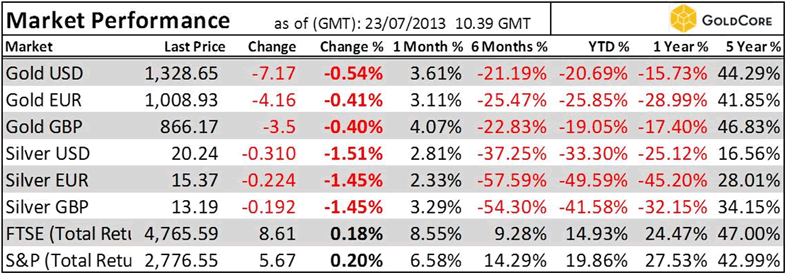
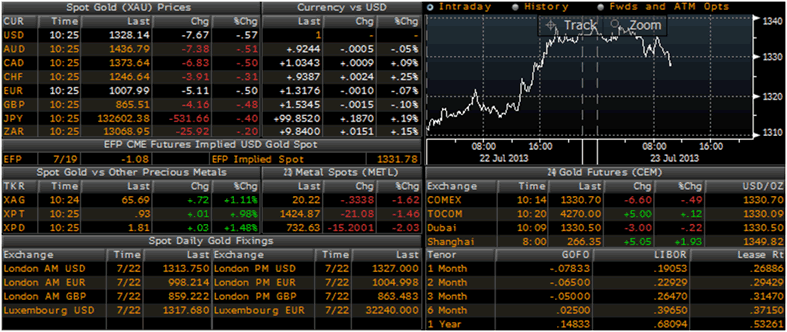
Today’s AM fix was USD 1,326.75, EUR 1,007.10 and GBP 864.84 per ounce. 

Yesterday’s AM fix was USD 1,313.75, EUR 998.21 and GBP 859.22 per ounce.
Gold climbed $39.30 or 3.04% yesterday and closed at $1,333.70/oz.
Silver surged $0.97 or 4.98% and closed at $20.46.
Gold Prices/Fixes/Rates/Vols – (Bloomberg)
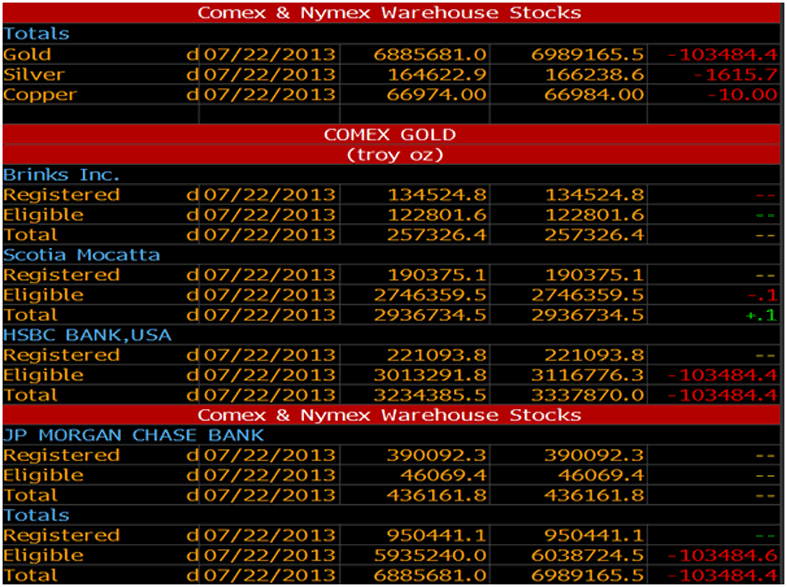
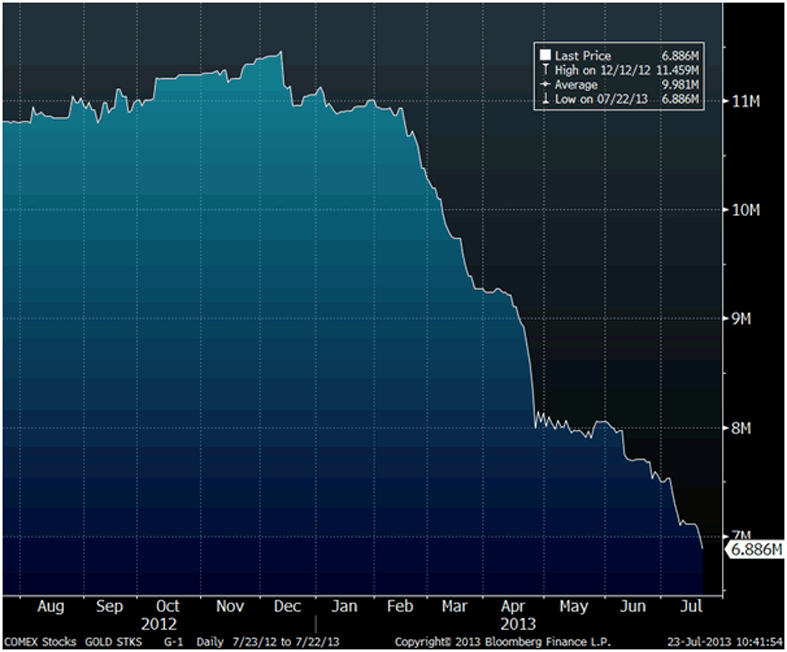
Gold surged over 3% yesterday due to what appears to be have been significant short covering due to concerns about gold backwardation and the continual haemorrhaging of gold inventories from the COMEX.
Concerns about a default on the COMEX, once the preserve of a few observant market watchers, are becoming more widespread as we appear to be witnessing a run on the highly leveraged bullion banking system.
Very robust physical demand from the Middle East, Asia and particularly China and a decline in the dollar also helped prices log their biggest one-day gain in over a year and their first close above $1,300 an ounce in nearly five weeks.
Gains in silver futures, meanwhile, outpaced gold’s rise, with silver surging 5%.
Gold may have been higher also due to the weak U.S. dollar which is under pressure from poor U.S. home sales and comments from Bill Gross, PIMCO co-chief investment officer, who said he expected the Fed won’t tighten policy before 2016.
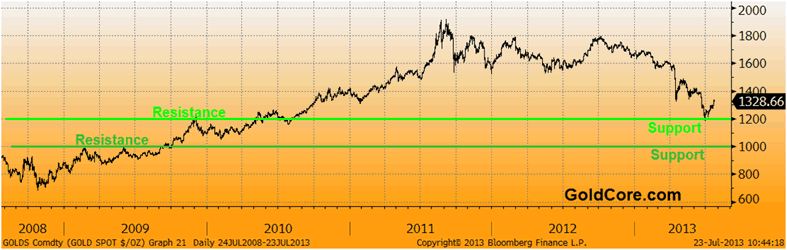
Gold has recovered nearly $150 or more than 12% in less than a month since hitting a three-year low of $1,180/oz on June 28th. Gold has made the strong gains due to robust physical demand as seen in the still high premiums in Asia.
Respected investor and precious metals guru, Jim Sinclair has again warned of a risk of a default on the COMEX and said that gold prices will rise to $3,500/oz and that gold at $50,000/oz is “not out of the question.”
Sinclair, the successful gold and silver investor and a former adviser to the Hunt Brothers in their liquidation of silver from 1981 to 1984, said in a posting on his blog that was emailed out to subscribers that:
“The cause of today’s spectacular rise in the gold price is the reality that with Friday continues large drops in the Comex warehouse gold inventory. No cogent argument can be formed against the reality that because of the continued fall in gold inventory that within in 90 days or sooner the Comex must change its delivery mechanism.”
Sinclair, said that the COMEX would have to move to cash settlement as they do not have nearly enough gold bullion to make deliveries and warned that owners of futures may be forced to accept payment in the form of the SPDR GLD ETF. This which would make them unsecured creditors of the bullion banks who are the custodians and sub custodians of the SPDR GLD.
He said that this could lead to the GLD ETF being “destroyed” and said that “it is a truism in gold that which is convertible into gold will in fact be converted over time.”
Comex Gold Inventory Data
Sinclair was likely alluding to a form of Gresham’s Law where bad money drives out good and where ‘bad’ or more risky gold investments are driven out by ‘good’ or safer gold ‘investments’ such as physical bullion in your possession or allocated in a vault outside the banking system.
Gold rose yesterday and Sinclair said, “because those knowledgeable know the inevitability of the changing of the Comex contract.”
“There is no question this is the emancipation of physical gold from the fraud of no gold, paper gold. The emancipation will cause physical gold exchanges to take birth and to be the discovery mechanism for the price of gold. This is the end of the ability to use paper gold future contracts as a mechanism to make the gold price sing and dance at the will of the manipulators.
With manipulation coming to an end the true value of gold will be discovered by the cash exchanges that are now taking birth. The advent of the cash spot exchanges around the world is the natural demise of the Comex.
GOFO (Gold Forward Offered Rate) is screaming this truth. The warehouse inventory of every futures gold exchanger is screaming this. The fact that there is no meaningful above ground supply of gold is screaming this. The fact that most of the central banks supply of gold is leased is screaming this.
There is no reason why gold cannot move up hundreds of dollars a day when the Comex changes their spot contract settlement, as they must, as they will, very soon.”
Support & Resistance Chart – (GoldCore)
With regard to price, Sinclair said that “gold will trade well above $3,500/oz and those who have lived in the gold market like me for now 53 years know it”.
The respected investor said that “a price of $50,000 for gold is not out of the question as a result of its emancipation from “fraudulent paper, no gold, paper gold.”
Mr. Sinclair has a good track record and it is believed that he has insider knowledge due to his family history and relationships with key players on Wall Street.
He predicted back in the early 2000’s with gold below $300 an ounce that gold would reach $1,650 within a decade. Now he is talking about “quantitative easing to infinity” and a similar trajectory for gold and silver prices.
Sinclair is highly respected amongst precious metal buyers due to being extraordinarily generous with his knowledge and his time in recent years. His writings on his website JSMineset and his free email have protected tens of thousands of people around the world.
This year he has undertaken conferences where hundreds of people have turned up in Los Angeles, London and New York City for highly informative, interactive, question and answer sessions and is holding more conferences around the world in the coming months.
For the latest news and commentary on financial markets and gold please follow us on Twitter.
GOLDNOMICS – CASH OR GOLD BULLION?

‘GoldNomics’ can be viewed by clicking on the image above or on our YouTube channel: 
www.youtube.com/goldcorelimited

This update can be found on the GoldCore blog here.
Continue Reading
GlobalIntelHub2

Why Cybersecurity Stocks Are One of the Best Investments You Can Make Right Now

Tara Clarke writes: or months now, we’ve been harping to our readers about why cybersecurity is one of the absolute best investments you can get involved with right now.Now the rest of the financial media is catching on.This weekend, Barron’s profiled …

Continue Reading
GlobalIntelHub2

SEC Charges Texas Man With Running Bitcoin-Denominated Ponzi Scheme

FOR IMMEDIATE RELEASE
2013-132
Washington D.C., July 23, 2013 — 

The Securities and Exchange Commission today charged a Texas man and his company with defrauding investors in a Ponzi scheme involving Bitcoin, a virtual currency traded on online exchanges for conventional currencies like the U.S. dollar or used to purchase goods or services online. 
The SEC alleges that Trendon T. Shavers, who is the founder and operator of Bitcoin Savings and Trust (BTCST), offered and sold Bitcoin-denominated investments through the Internet using the monikers “Pirate” and “pirateat40.”  Shavers raised at least 700,000 Bitcoin in BTCST investments, which amounted to more than $4.5 million based on the average price of Bitcoin in 2011 and 2012 when the investments were offered and sold.  Today the value of 700,000 Bitcoin exceeds $60 million.
The SEC alleges that Shavers promised investors up to 7 percent weekly interest based on BTCST’s Bitcoin market arbitrage activity, which supposedly included selling to individuals who wished to buy Bitcoin “off the radar” in quick fashion or large quantities.  In reality, BTCST was a sham and a Ponzi scheme in which Shavers used Bitcoin from new investors to make purported interest payments and cover investor withdrawals on outstanding BTCST investments.  Shavers also diverted investors’ Bitcoin for day trading in his account on a Bitcoin currency exchange, and exchanged investors’ Bitcoin for U.S. dollars to pay his personal expenses.
The SEC issued an investor alert today warning investors about the dangers of potential investment scams involving virtual currencies promoted through the Internet. 
“Fraudsters are not beyond the reach of the SEC just because they use Bitcoin or another virtual currency to mislead investors and violate the federal securities laws,” said Andrew M. Calamari, Director of the SEC’s New York Regional Office.  “Shavers preyed on investors in an online forum by claiming his investments carried no risk and huge profits for them while his true intentions were rooted in nothing more than personal greed.”
According to the SEC’s complaint filed in U.S. District Court for the Eastern District of Texas, Shavers sold BTCST investments over the Internet to investors in such states as Connecticut, Hawaii, Illinois, Louisiana, Massachusetts, North Carolina, and Pennsylvania.  Shavers posted general solicitations on a website dedicated to Bitcoin discussions, and he misled investors with such false assurances about his investment opportunity as “It’s growing, it’s growing!” and “I have yet to come close to taking a loss on any deal,” and “risk is almost 0.”  Contrary to the representations made to investors, BTCST was not in the business of buying and selling Bitcoin at all.
The SEC alleges that Shavers, who lives in McKinney, Texas, paid 507,148 Bitcoin in investor withdrawals and purported interest payments.  He transferred at least 150,649 Bitcoin to his personal account at an online Bitcoin currency exchange.  Shavers suffered a net loss from his day trading, but realized net proceeds of $164,758 from his sales of 86,202 Bitcoin.  Shavers transferred $147,102 from his personal account at the online Bitcoin currency exchange to accounts he controlled at an online payment processor as well as his personal checking account.  He used this money to pay his rent, utilities, and car-related expenses as well as for food and retail purchases and gambling.
The SEC’s complaint charges Shavers and BTCST with offering and selling investments in violation of the anti-fraud and registration provisions of the securities laws, specifically Sections 5(a), 5(c) and 17(a) of the Securities Act of 1933, Section 10(b) of the Securities Exchange Act of 1934 and Exchange Act Rule 10b-5.  The SEC is seeking a court order to freeze the assets of Shavers and BTCST in addition to other relief, including permanent injunctions, disgorgement of ill-gotten gains with prejudgment interest, and financial penalties.
The SEC’s investor alert, prepared by the agency’s Office of Investor Education and Advocacy, recommends that investors be wary of so-called investment opportunities that promise high rates of return with little or no risk, especially when dealing with unregistered, Internet-based investments sold by unlicensed promoters.
“Ponzi scheme operators often claim to have a tie to a new and emerging technology as a lure to potential victims,” said Lori J. Schock, Director of the SEC’s Office of Investor Education and Advocacy.  “Investors should understand that regardless of the type of investment, a promise of high returns with little or no risk is a classic warning sign of fraud.”
Continue Reading